


When I was a young man and read a lot about philosophy I came across Stephen Jay Gould’s concept of “non-overlapping magisterium” - the idea that science and religion made non-overlapping claims about reality and you couldn’t critique one from the perspective of the other.
I remember reading this and thinking—damn, this guy is completely retarded.
Of course, I still believe that.
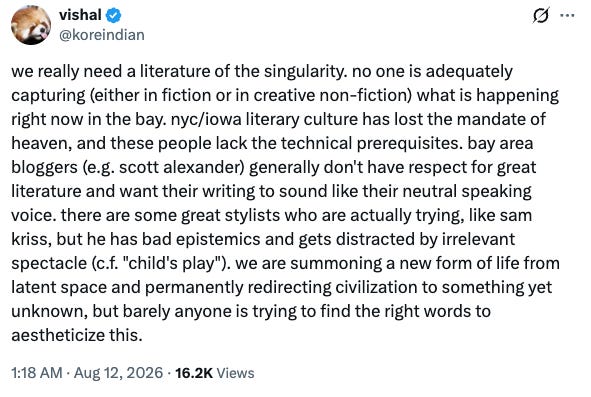
This is obviously wrong and untenable and what ended up happening is that secular liberalism won a philosophical war which overdetermined the next thing that happened: after winning a philosophical war, it won the culture war, and, in the process, drained any residual elan vital that remained in mainline Christianity (and evangelicism in particular) from the body politic and the zeitgeist more broadly.
We are now living in the era of the singularity and it is a decidedly post-theistic era.
(In case you didn’t notice, we’re building god out of sand, etcetera etcetera).
It is apparent to me that to whatever extent we see some level of niche counter-cultural adoption of religiosity it’s an aesthetic costume as commodified as any other (e.g. tradcaths, orthobros, etc.).
It’s not serious.
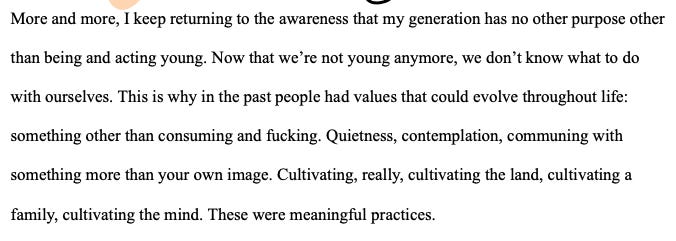
This is one reason I like Gasda’s writing: his work contains many of the latent moral anchors of Christianity but he’s honest about the fact that their metaphysical foundations have dissolved into modernity. It’s interesting because, like many in New York City, his protagonists have drank and drank until their cup runneth over, only to arrive at the same conclusions that were evident over two millennia ago:
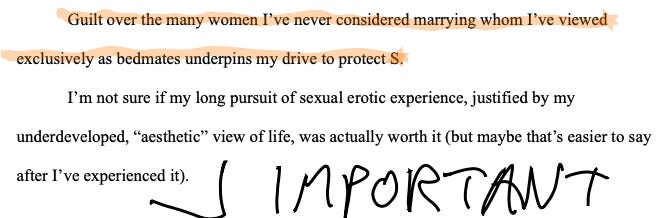
Contemporary American culture feels like we’re speedrunning a series of longstanding Protestant social norms and then re-learning some variation of “so it turns out it’s Chesteron’s fence all-the-way-down.”
But history, you see, is a ratchet that only goes one way.
The lesson here is simple: systems of thought compete with one another, and totalizing systems defeat weaker systems in the memetic commons.
Insofar as “market capitalism induces you to cum as much as possible in as many ways as possible with minimal latency” is a system of thought, it’s fucking invincible, dawg.
Silicon Valley is a system of thought that has defeated New York City as a system of thought. GPU’s go brrr and the value of the text trends to zero and the literati get nuked from orbit into nanoscale cultural irrelevance and even grandpa is watching Tik Tok dances by nulliparous young Asian women instead of reading Faulkner.
And yet, interesting work can come out of tension: the tension that exists between the literary class and the engineers who are shaping the world of the future.
One way of putting the problem:
Silicon Valley thinkers like Richard Ngo have thought very deeply about the future and what it would look like and sometimes write interesting short stories about the future, but are not practiced in the particular form of prose artistry and deep literary character-building or mood-setting in the same way that elite novelists are.1 This isn’t unreasonable, we can’t expect these guys to be Cormac McCarthy.
Elite novelists are oftentimes skilled prose artists or carefully observed painters of human character & psychology, but lack even a basic understanding of the technological precipice we’re in. Half of them still seem convinced of the “stochastic parrot” thesis, meanwhile, agent swarms are clearly already capable of automating most of the white collar economy.
Consider the state of technology in the golden era of modern literature—roughly the 50’s to the 80’s/90’s. So much incredible work got made in this era and we’re still (rightfully) enjoying it decades later.
But why?
Think about the world in which these writers lived. Planes, trains, automobiles, cities—these parameters of their physical space were not dramatically transformed over four decades. Even complex mechanical systems would have been legible to even the ancients in a way that digital systems could not be. A car engine is not wholly alien to the object-permanence of the ape-brain. You could be a novelist and be largely ignorant about, say, internal combustion engines, because your world-model didn’t dramatically shift in response to the latest iteration of motor vehicles, and so on. Thiel has correctly argued this.
A more precise cut of my thesis: specialization in academia and the self-sorting and self-selection of social circles in the arts leads to two structural problems for modern novelists:
They have little to no understanding of the historical precipice we’re in—of transformative artificial intelligence. This likely holds true even if AI is merely a “normal technology” since the potential for labor disruption and power concentration remains incredibly severe.
The entire fulcrum of history now turns on (1). But the modal contemporary novelist cannot write a novel that includes this in their world-model. So literature that’s ostensibly contemporary really isn’t topical at all but focused on petite subcultural dynamics that have already melted into air like varying forms of race opera, affairs between creative writing professors and their students, and so on.
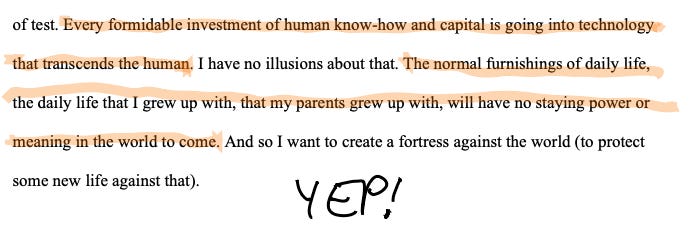
Here’s the fact of the matter: the year is 2026 and the art we make in the next 5-10 years might be the last meaningful art that can be made before machine intelligence maps the neural territory required to create aesthetic superstimulus - i.e. Erik Hoel’s “semantic apocalypse” theory.
I say this as someone who likes literature, wordcels, and the peoples of the humanities class. Substack is the perfect platform for aging, childless millennials to commiserate about our dying niche conservatory art form five minutes before the singularity uploads us into a data center or repurposes our atoms into hedonic computronium to simulate Chinese heaven for a googleplex worth of digitized shrimp-brains.
Do you understand what time it is?
Enter Gasda
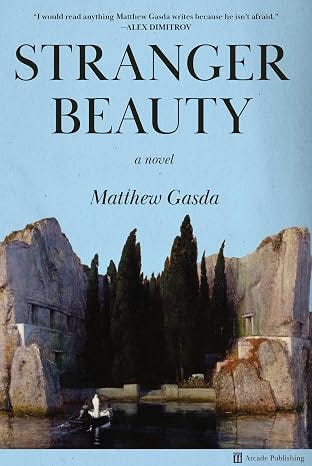
Stranger Beauty is an experimental novel about the near-future.
Gasda, unlike most novelists of this generation, pays close attention to the moment we’re in and the implications it has for the future.
It’s impossible to talk about this book without talking about the structure.
The novel has a hybrid structure, broadly spanning a couple of shifting forms:
A conventionally structured fictional narrative about a playwright/writer and his young family set “five minutes” in the future - a city with drones, regenerative neurological treatments for otherwise catastrophic brain injures, personal AI’s, and so on.
A winding, non-linear diary of existential observations, aphorisms similar to his writer’s diary.
A screenplay of an experimental, dreamlike film.
A stream-of-consciousness concluding sequence.
Gasda’s work in context
I’ve never seen any of his plays but my readers will know that I was a big fan of his novel The Sleepers (published by ARCADE PRESS).
What made The Sleepers particularly good was how the narrative organically plays out the essential critique of liberalism - liberalism is just the inability to marry a single person and relinquish the pleasure of sex with new people which is modernity which is wireheading, and even if the civilizational critique of wireheading is perhaps latently Christian (Gasda especially so?) it’s not invalid from a reproductive perspective.
New York, as Land would say, is not just an IQ-shredder, it’s an IQ-shredder that satiates you by jerking you off with the flesh of other people.
Stranger Beauty does not anchor itself on that same thesis. It’s something else, something—well—stranger, but it periodically calls back to the hedonism of city life.

Hedonic treadmills have multiplied in the future, but aren’t what the book is really about.
What paying attention looks like
The book starts with the basic premise of “what might the world look like in the near-future”?
It follows, basically, a version of the “AI is a normal general purpose technology” outlined by academics like Jeffrey Ding—notably different, but not to the level of Dyson spheres or Skynet-style apocaplypse.
Imagine a world where we get superhuman coders, mathematicians, but this intelligence explosion remains bottlenecked by limited verifiable data from the real world.2
The near-American future of Stranger Beauty is an interregnum period—likely temporary, unstable, and certainly dreamlike, with humanity being lifted from the moorings of our comparative technological stasis as we ascend the terminal spiral of progress.
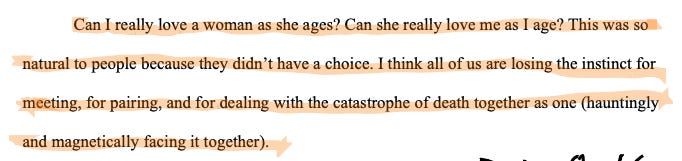
Gasda’s world-model of the future has drones, regenerative neurotechnology, ubiquitous conversational AI’s, but can best be characterized as a simple extrapolation of the current moment:
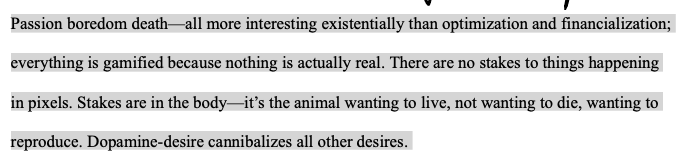
I was interested in the setting in the novel, which was painted in broad brushstrokes rather than William-Gibson-style intensely detailed world-building.
The book is relentlessly existential.
It’s like looking at our current wasteland of smartphone addiction, limbic capitalism, meaningless sex, and concluding that it’s only going to get worse from here, and asking the question—wait, it’s only going to get worse???
So what’s it actually about?
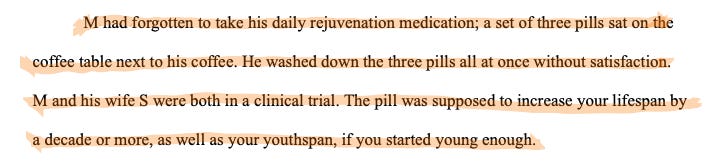
I could tell you about the plot but it’s not a plot-driven novel; it’s a mood-piece that asks whether or not your soul is going to survive the meat-grinder of technocapital up to and including the moment where nanomachines reconstitute your neurons in the wake of catastrophic brain damage:
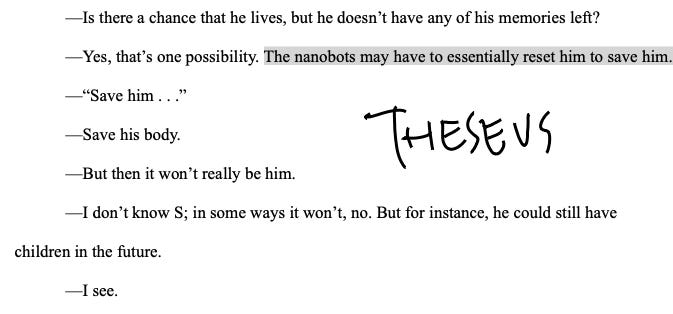
The answer, he says, is yes (maybe).
And I had to think about the answer for a long time, because even after finishing the book, I wasn’t sure if I was correctly understanding it. In part the decoherence feels deliberate because the future is going to cause so many of you to dissociate severely, irreversibly, and most of us will not come out of the other end wholly ensouled.
Structure, momentum, and ambition
It’s clear the book is ambitious and this ambition is in part why I felt compelled to write a review. I had originally intended to combine it with a review of his play, DOOMERS, but I’ll be bracketing that out for a future review.
The key question for me, as a reviewer, is whether or not the unique structure of the book works both as a whole and as individual sections.
Sleepers has a broadly conventionally structure, for example, and was executed very well in that respect. Although it hybridized elements of theatrical structure, it was very tight structurally.
What Stranger Beauty tries to accomplish is substantially more difficult for two reasons:
It’s both harder and easier to write a minimally-plotted, “plotless”-style of novel (the literary equivalent of the “slice-of-life anime”) because each page has to be compelling in isolation even though you’re liberated from the constraints of “what happens next.” Teju Cole’s Open City is an example of this done well, and his book Tremor is him failing at the same task.
Doing this and also doing three others things is even harder. By default, abrupt, segmented blocks of distinct formal styles breaks continuity in the mind of the reader without expert-level compensatory machinations.
A good example of this are the transitions between the conventional novel’s story and the diaristic aphorism sequence that repeatedly intercut the more standard-style narrative. I found the former interesting and the latter lacking in momentum. Whatever forward movement I felt in the core story felt broken by the interruption of the existential diary pages, which, while sometimes compelling in isolation (see some quotes above), didn’t quite congeal into a unified stream. With an approach like this, whole must be greater than the sum of its parts. Certainly one could argue that this disorientation was a deliberate and conscious stylistic risk, but for me as a reader, I found it challenging to feel like I was being pulled forward through the novel in the way that I like to be drawn into a book.
Whereas Sleepers had a tremendous sense of momentum and impending doom, Stranger Beauty is more slowly paced, but I think the pace felt too slow for me throughout.
Interestingly, the screenplay-sequence is the strongest section of the book and the most conventionally structured. Even outside of this sequence, I felt that the skeleton of the story would have lent itself incredibly well to a Gaspar Noe-style ENTER THE VOID type of film. The novel almost begs to be converted into a strongly opinionated visual medium (and indeed I hope that does happen one day!).
Even if the structure didn’t quite work for me, the book makes a sincere attempt to grapple with the cavernous despair of our coming post-labour future. Its philosophical salience is meaningful and topical, centering around questions in philosophy of mind, wireheading as an intrinsic attractor-basin for technocapital, and human-AI relationships. It’s valiant in that it confronts the future rather than evading it.
What can I say?
It’s a strange book, and, in fairness, the author told you it was going to be (it’s in the title, after all!).
No offense, Richard, I think your stuff is great!
For a great post on this, read Tom Reed’s well-articulated argument here.
You are cooking
I am not as much of a doomer as others when it comes to AI. It seems me that Silicon Valley has essentially created an alternate lifeform with an alternate mode of thinking. "Labor gives meaning" never made sense to me. No one likes to work. I guess it's because my job isn't that important (I'm a paralegal) I also want to make a distinction between labor for income and creative income. Why does it matter to me that AGI can write or do my job better than me? I still like to write creatively. People still play sports even though they'll never be the "best" at it. It doesn't really matter to me. Maybe I'm being naive.
How others feel about this also important. And how can AI even interface with the real world when it has no body? I am a little ignorant on robotics so maybe I'm wrong. Anyway, all of this is still up on the air. Once mass unemployment occurs, then we'll start getting answers. Whatever happens, history will keep going. That's what matters to me the most.