


Recently, I accidentally deleted my Twitter during a temporary account deactivation period that was driven by my need to focus better in my real life.
This year hasn’t been a great year for my own personal reading.
I’ve only read about 30 or so books, which is well short of my goal for 50 books a year. A big part of this has been an excess amount of doomscrolling geopolitics/AI twitter late into the night instead of reading.1
Anyhow, this recent bout of increased distraction got me thinking about the relationship between book length and literary success.
Among the very small cohort of notable contemporary indie literary novelists, I am only aware of two self-published writers who have achieved a meaningful volume of sales: Mike Ma and Delicious Tacos.2
The majority of my literary analysis on this blog is focused on style, authorial craziness, ideological payloads, and politico-cultural context, but I want to set all of that aside and briefly focus on the simplest possible metric for analyzing a book’s ability to gain a readership—its length.
Mike Ma’s first novel, Harassment Architecture, has over 1,000 reviews on Amazon.3
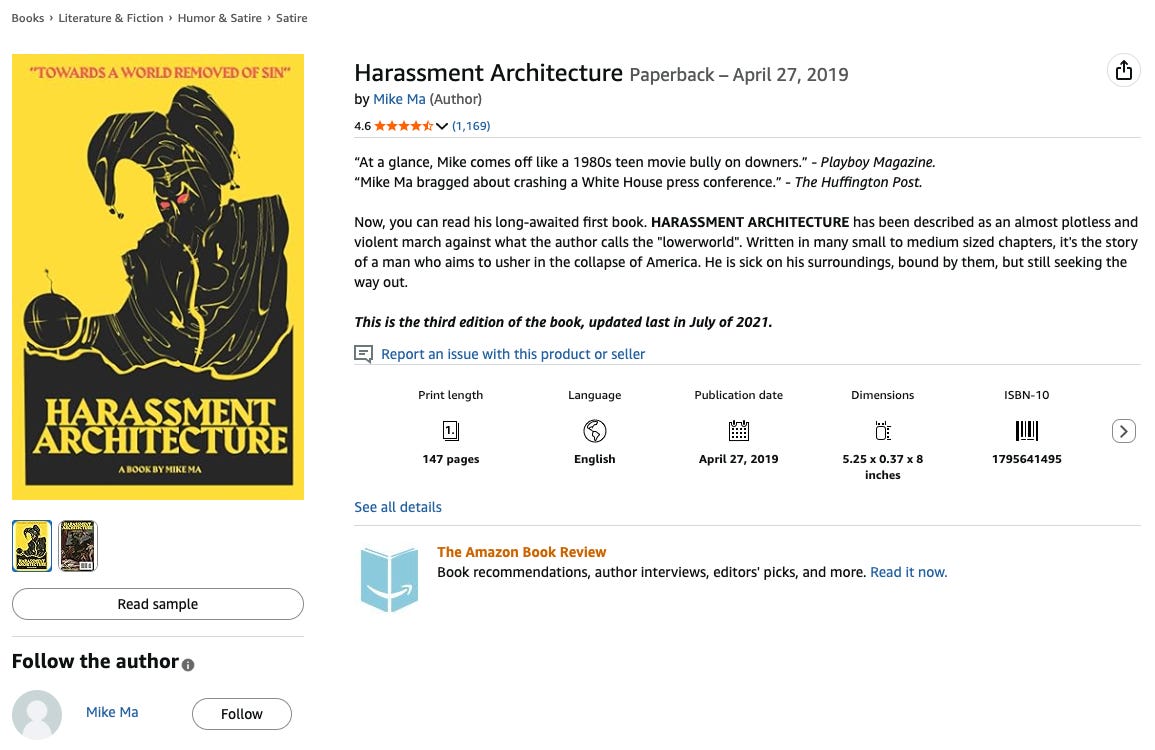
I asked an LLM to estimate its sales volume based on Amazon Best Seller Rank (ABSR) + some other data like Amazon reviews, and it estimated that this book has sold ~10,000 to 25,000 copies.
By the standards of literary fiction, that is a very large number.
It’s 147 pages long—a short, novella-scaled read.
Delicious Tacos, who is now arguably more widely known (given that Mike Ma has withdrawn from public social media), has accumulated about ~500 reviews for his debut novel:
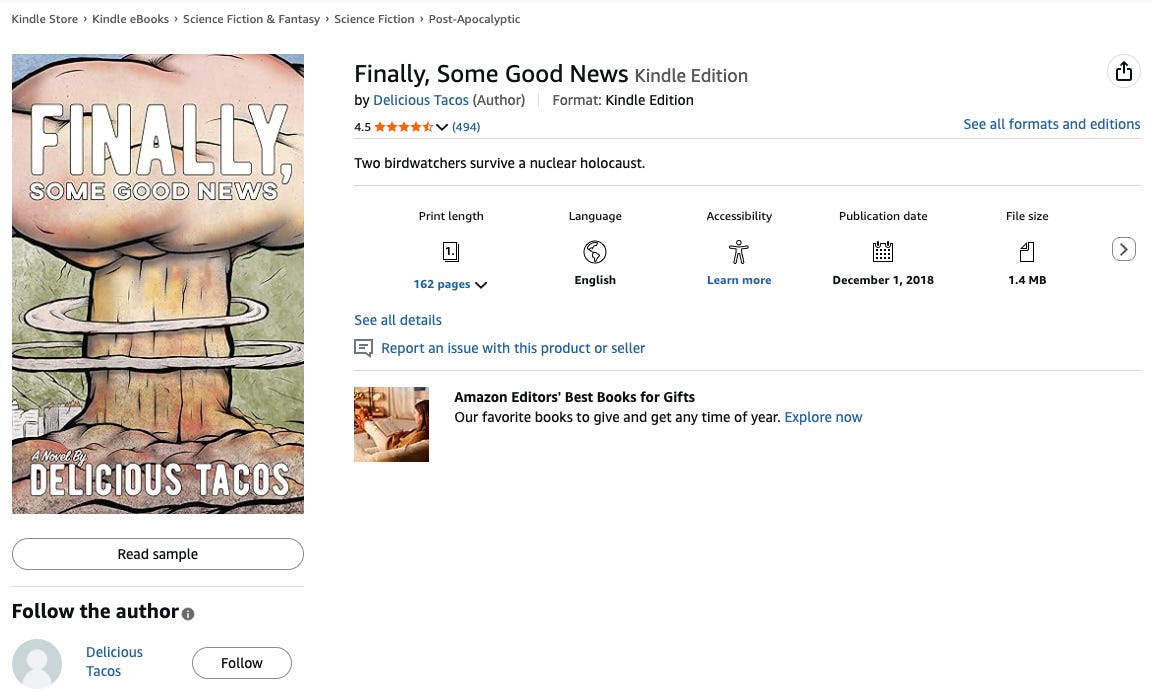
Tacos wrote a similarly short book (162 pages) which my LLM estimates as having sold ~4,000 to 10,000 copies.
Even by the standards of the median publisher-backed literary novelist, these figures would be considered very good (or even exceptional) outcomes, and I have to wonder if book length was one of the decisive variables that made these sales figures possible.
In the counterfactual scenario, where each novel is 2-3x as long, would these books have taken off in the same way?
Obviously, word count is not a sufficient criterion for literary success, but perhaps it is an increasingly necessary one—particularly for the non-established, indie writer.
I like short books in part because I am enormously distracted by the internet and because I enjoy the satisfaction of having read a book to completion.
On the other hand, a writer should not limit his or her ambition to the attention spans of the market, and you have guys like John Pistelli who’ve done great with longer works as well.
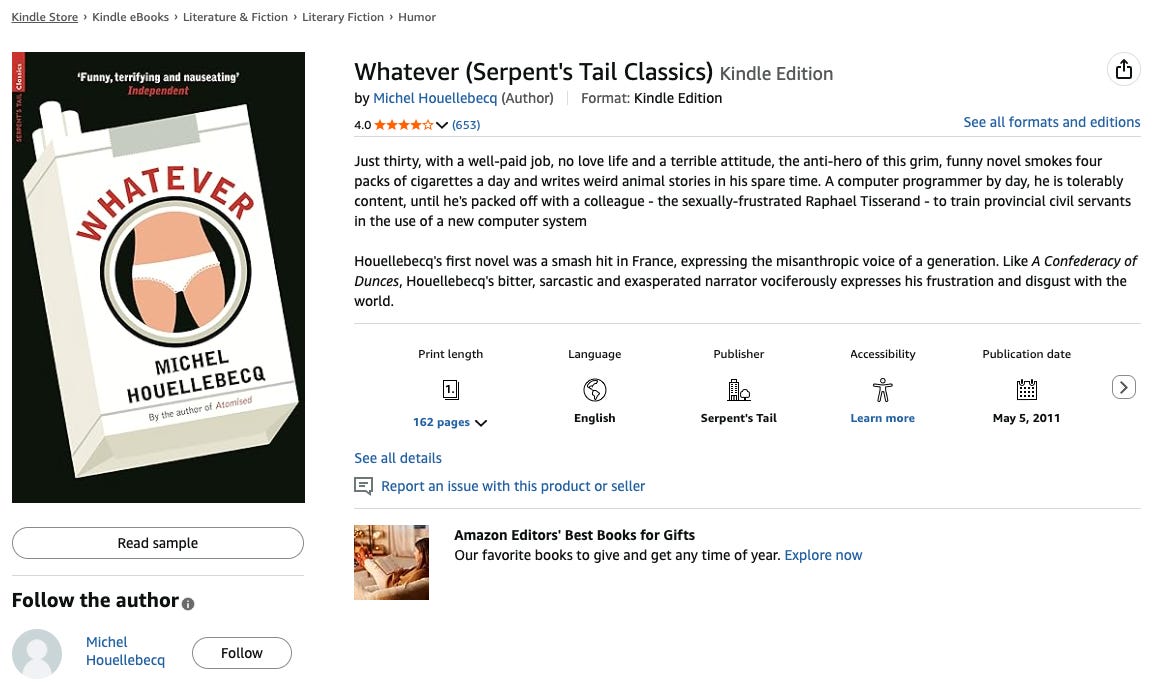
That said, I’m tempted to anchor on the brevity of Houellebecq’s debut, Whatever, which clocks in at 162 (Kindle) pages:
I have a theory.
From the perspective of a reader, a novel is a significant time investment.
Relative to the plethora of narrative entertainment options that are available, it’s a big ask.
A debut novelist is asking a reader for their time and attention. In sales, it’s easier to make a smaller ask than a larger one.
I greatly enjoyed writing a medium-length novel (about ~90k words or so), but I think that the length of the book was in part a “barrier to adoption,” as the techbros like to say.
Thus, for my next novel, I intend to write something much shorter—something that’s roughly the length of Osamu Dazai’s No Longer Human, or Houellebecq’s Whatever. I’ve convinced myself that this impulse is coming out of inspiration from the 20th century Japanese modernists and not from my craven desire for increased approval and recognition.
That’s the funny thing about book sales as a writer—no matter how many you have, it’s never enough.
By “meaningful,” I mean “at least several thousand sales.”
This book has notably been the subject of some degree of controversy given the author’s apparent political views and attendant social media activity.
Fifty thousand-word novels are what the majority of readers can assimilate and review.
I recall Bellow’s afterword in the Collected Stories admonishing writers to write “as short as they can.” I think 100-220 is probably the ideal zone.
But at the end of the day, we should just follow what the work dictates.