


Outside of New York, being a novelist is a lonely vocation.
Few people read and I’m always surprised when I meet someone under 40 who reads literary fiction. When I mention I read (or write), people are mildly impressed and the conversation quickly shifts to the next topic of actual interest. Relative to the position of being a novelist, when I add the additional elements of being Asian-American, and, more specifically, Chinese-American, this feeling of loneliness compounds a little bit more, but not by much.
I think the element of race in my fiction is ultimately not so central. On some level I hold the sentiment that all men are my brothers, and, being Western-raised, my Asian-Americanness is largely phenotypic and therefore positionally determined—people treat me a certain way because of my appearance, a truism which applies equally to every person everywhere in the world. My height and my build and baldness are, in all likelihood, equally weighted variables that overdetermine the initial response function of existing in a social landscape in this particular body.
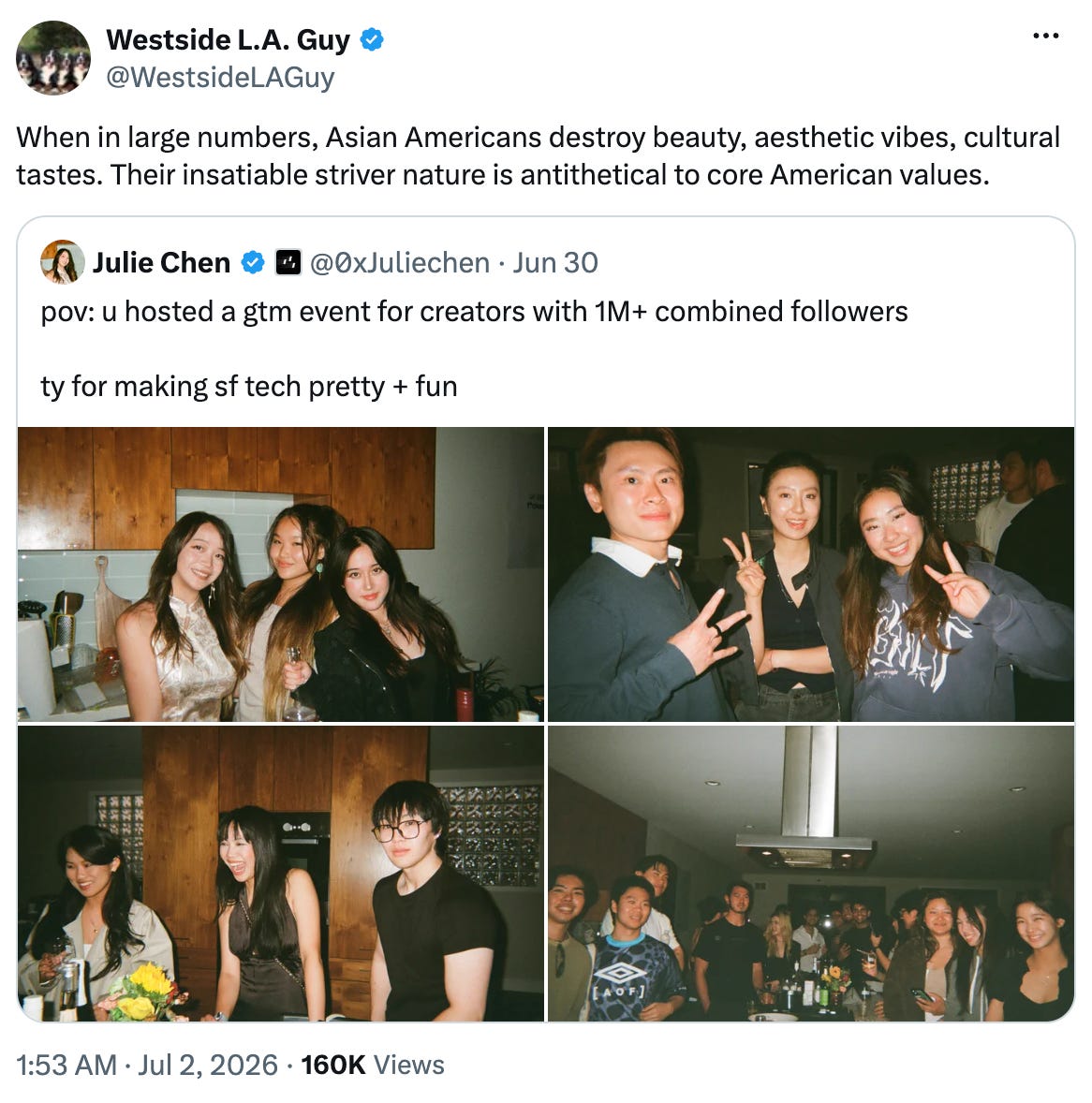
I’m currently working on a piece about how Asian-American culture is really just about the relentless pursuit of technocapital (and nothing else).
I think the reasons for this are difficult to model and extend beyond the typical argument about striverism and I’ll get into that later. But sufficed to say, even if we take the notably (cringe) landmark of Crazy Rich Asians, the operative words are not “crazy”—or even “Asian”—but “rich.”
Capital is the almost the universal pursuit of any capable Asian-American I’ve met and techne is the straightest path toward that accumulation. The most capable among us are basically all Gary Tans in the spiritual sense.
There are always exceptions: the Taiwanese-American film Didi, for instance, was very good.
But examples like this are few and far between. It’s not about one person pulling sword from stone and entering the pantheon of artistic or literary greatness. It’s about whether or not Asian-America can produce a cohort of people at that level.
If we widen our aperture to the global Sinosphere, the conversation becomes more interesting.
As part of the research for this piece I’ve been reminded of two notable East Asian successes: high-taste Korean filmmaking and Japanese auteurs.
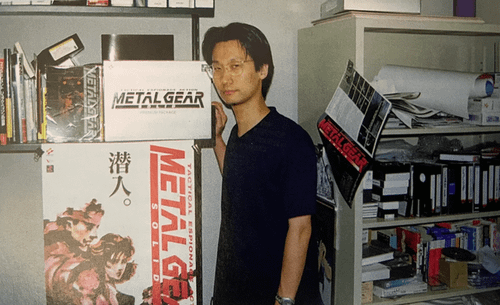
Of course, in the literary sense, we have the titans of late 20th century Japanese novelists like Osamu Dazai and Yukio Mishima, but with the example of Japan it’s particularly impressive how their culture of auteurship and artistry have extended across multiple domains. Hideo Kojima, for instance, is a generational interactive narrative-media auteur. Metal Gear Solid 1 & 2 have held up extraordinarily well over time, and if you look at the work of MIKE SUNDAY, you can see how deep Japan’s well of talent truly is.
Another example is Yousuke Yukimatsu’s breakout performance in Boiler Room went deservedly viral due the sheer manic energy of his performance, which has been clipped below. It’s hard to believe the man is over forty years old.
The reality is that even if they’ve largely departed from breakthrough contemporary literary fiction, the Japanese guys still have the sauce. That same pool of talent has just laterally transferred out of literary fiction into other mediums. If we move the map a bit, in live-action filmmaking, the best Korean guys have the sauce as well.
But what about the contemporary Chinese?
It’s a wasteland. You have to circle back to Asian-America.
Outside of notable exemplars like Ted Chiang or Ken Liu who both write truly stellar science fiction, I do not feel that Chinese guys have the sauce.
And that is because—and I suppose I can hardly blame them—they are currently engaged in a whole-of-society response that involves climbing the tech tree as fast as possible so that they can avoid getting obliterated by the American AGI wunderwaffen. This is a vacuum for elite human capital and sucks the energy out of the arts. And that’s even before we encounter the problem of a centralized censorship apparatus in the arts.
It would be easy to solely blame communism, but Chinese-American art isn’t much better than the homeland. Obviously, something deeper is going on here. I suspect it’s a deeper civilizational malaise.
Here’s an interesting theory from an account I stumbled upon recently:
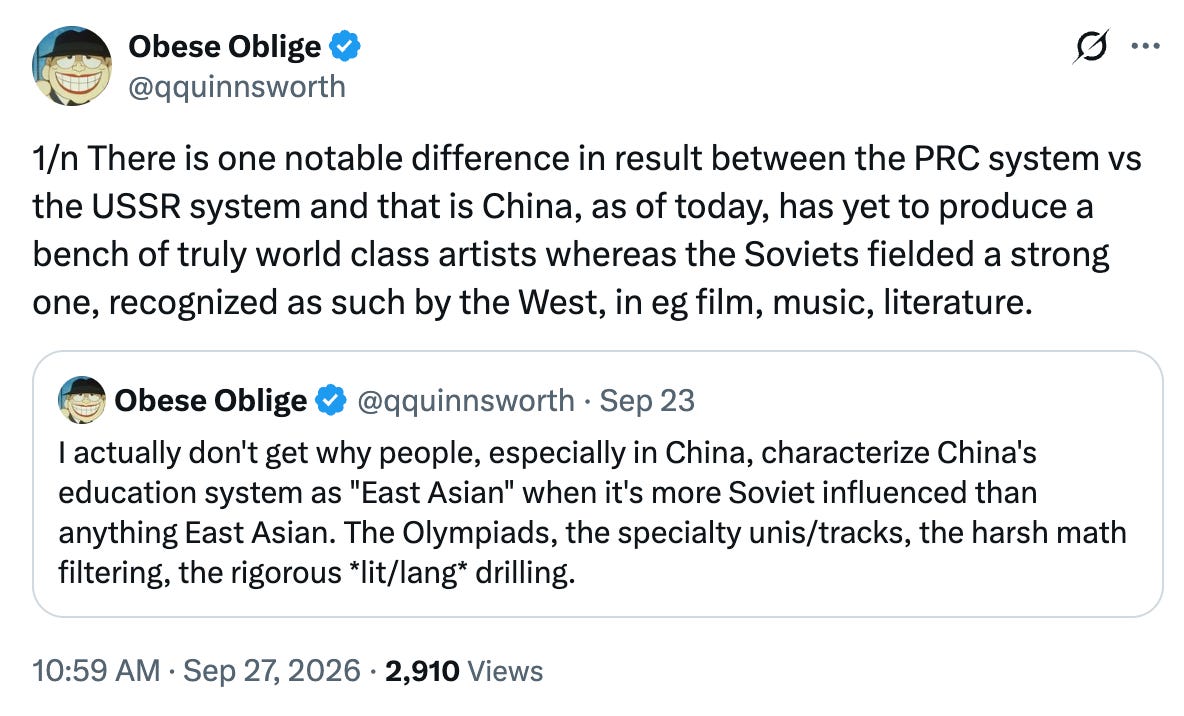
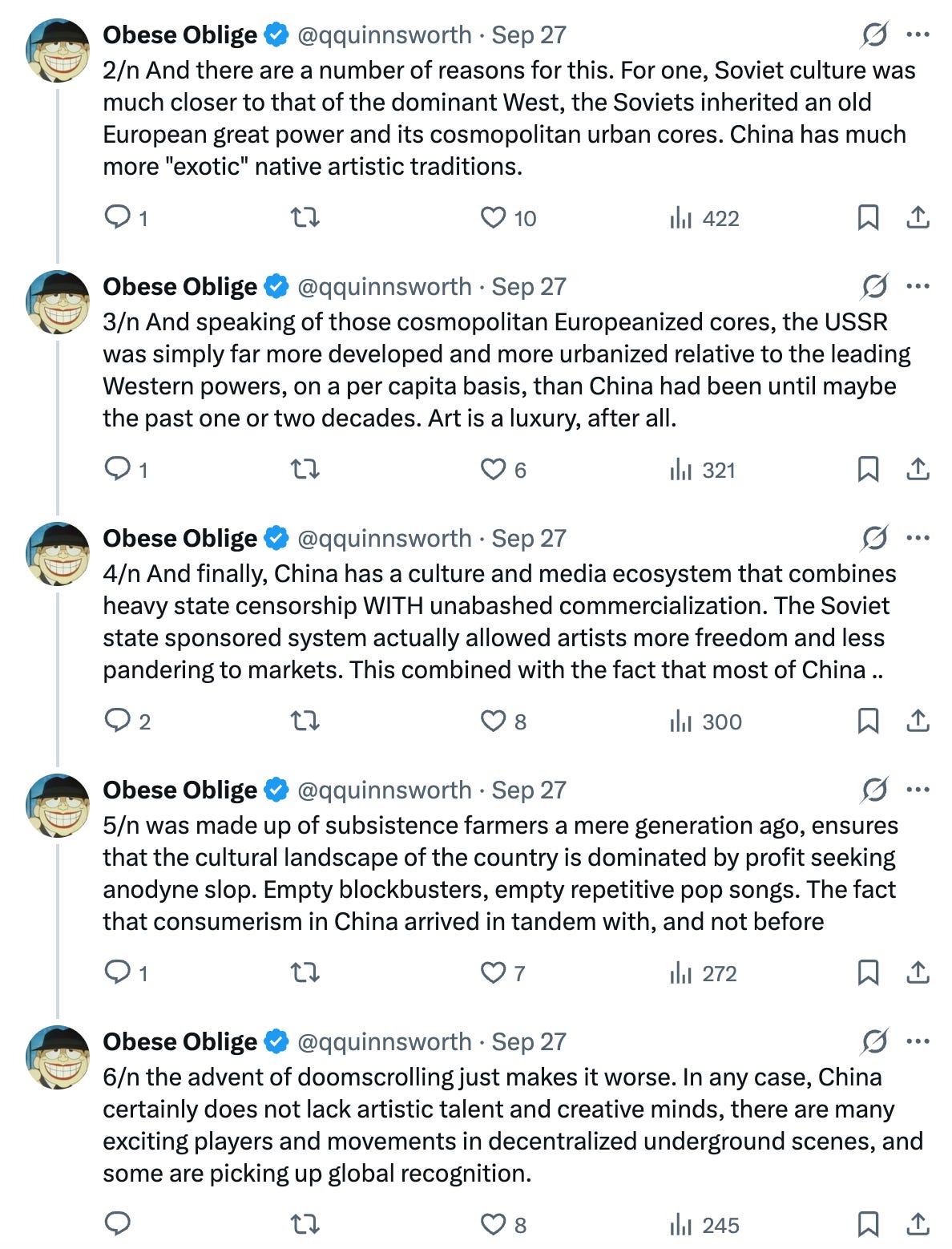
I do think things will get better over time, but it’s an interesting asymmetry to observe.
Who among us will pick up the crown and achieve the Great (cultural) rejuvenation of the Chinese nation?
I think China's great minds are busy creating a China impervious to the machinations of western oligarchs. There's something to be said for nation building.
I pray great Chinese art is completed so it may be immortalized before our Great American Wunderwaffen annihilate China and ensure eternal Amerislop supremacy