


I’ll admit to being a hater sometimes because there’s so much dog shit out there and I’m engaged in a practice of cultivation and aesthetic renewal and yes this obviously entails actively demeaning things I don’t like (by calling them “centralized” or by using some clever euphemism like that).
But, dear reader—you might be surprised to learn that the most important thing about being a professional hater is being humble.
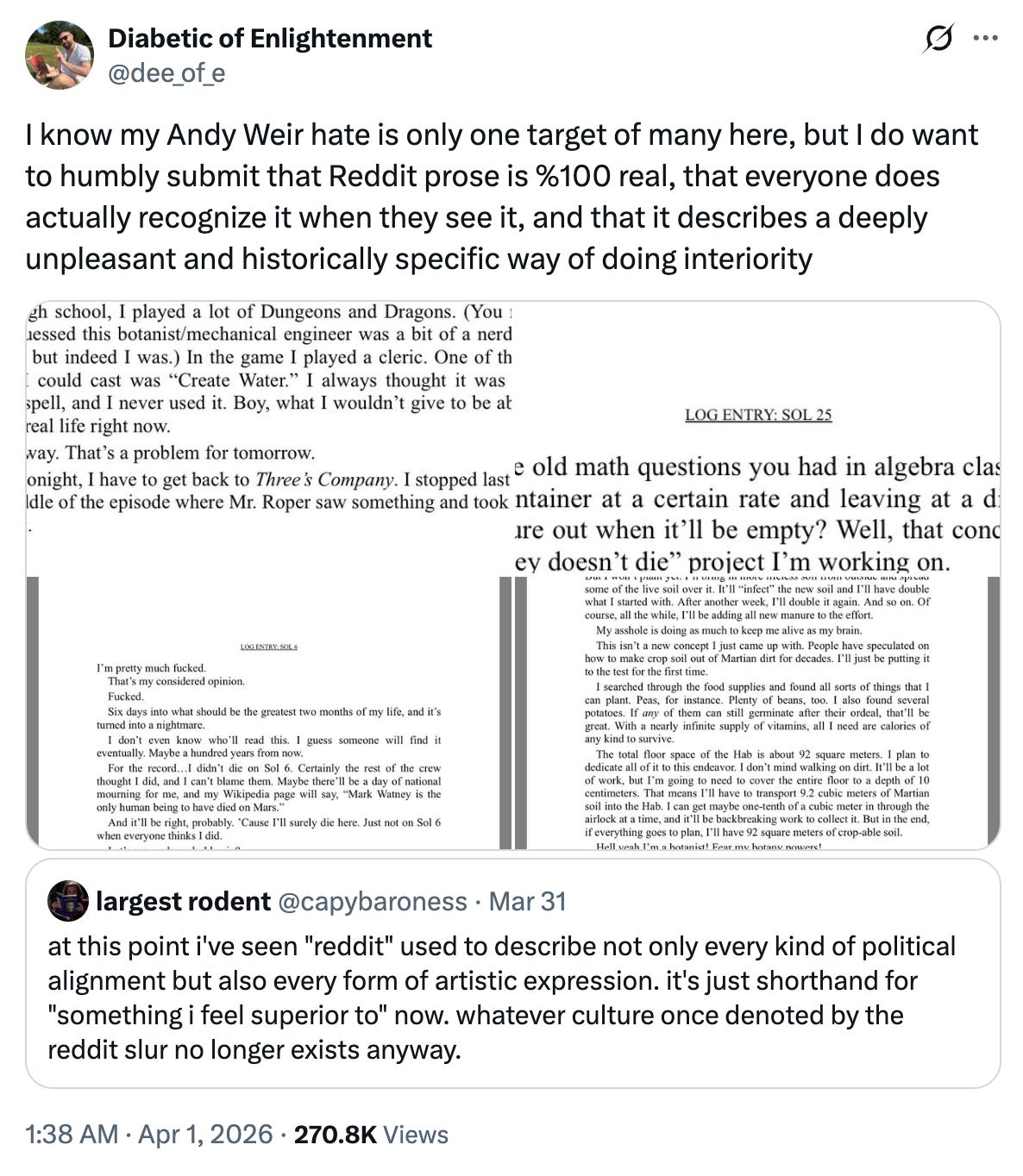
Recently I saw some guy complaining about Andy Weir’s sci-fi slop book Project Hail Mary doing extremely well in spite of its severely reddit-fried prose and generally terrible aesthetics and it reminded me of general principle that is too often lost on us.
Slop is its own form of genius.
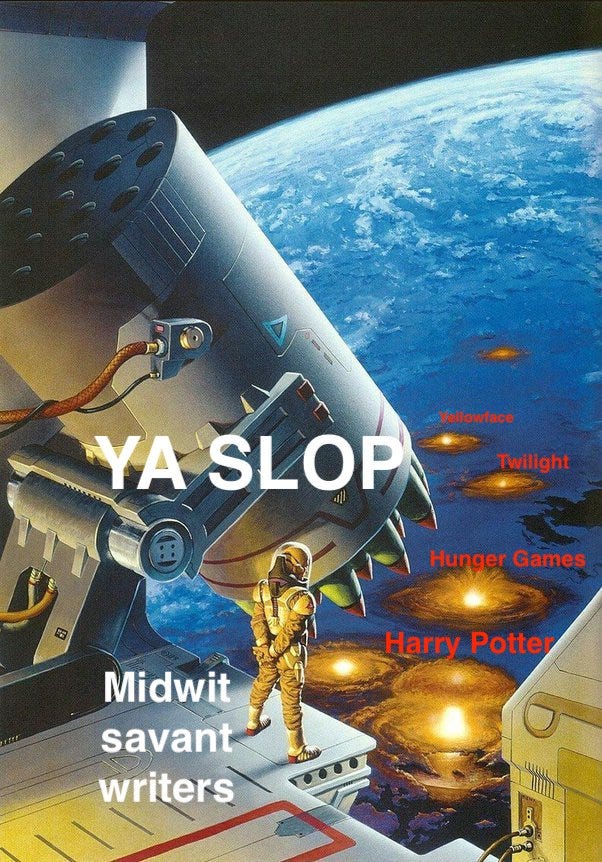
For the longest time I was loathe to admit this but if you really think through the extraordinary outperformance of YA slop like Harry Potter or Hunger Games it’s a little bit too easy to blame the luck factor.
The cynic’s perspective goes something like this:
Slop is more or less interchangeable.
Some combination of luck + marketing initiates a positive feedback cycle where positive attention begets more positive attention, and a book basically fooms into an exponential IP & sales success curve.
I think it is not quite right.
I think giga-slop authors are, in fact, truly special.
Not necessarily as artists but as narrative architects.
What’s actually happening, in my view, is something akin to a deep intuitive understanding of maximally-appealing narrative architectures.
If you analyze one of these books on a sentence-by-sentence level, you’ll miss the emergent metastructure of the story. Literary metastructure is the feeling that the reader gets from the work as a whole, and that is what makes it special.
The atomic subunits of this metastrucure (i.e. the sentences) are purely instrumental objects that exist to press buttons in the mind of an average person in the same way that you depress a sequence of keys on a piano. The truth is that a forest can be beautiful from a distance even if the trees are made of plastic.
Please note: it is extremely hard and functionally impossible to trigger a cascade of genuinely viral growth for a novel because the volume of books published every year is basically inconceivable. Almost definitionally, anyone capable of doing this possesses an innate kind of genius with regard to literary metastructure.
What Rowling does, for example, is some combination of immersive worldbuilding and British-elite school cosplay. Of course she’s not the first person to do this but the thing you need to understand about Rowling is the fucking Chinese hypersonic missile of Anglo-cosplay slop.
The Harry Potter series is basically a hyper-optimized anglophile status-pornography—something akin to orbital-dropping a British guy with an accent into the New York City dating scene in the late 90’s.
Hunger Games works because it’s a LARP that subconsciously convinces Americans they’re not the ones orchestrating the mass murder of poor people and children with advanced military technologies and are actually the underdogs in the meta-story of global historical geopolitics (i.e. pathological boomerism).
Twilight is the greatest vampire-fuck-fantasy that’s ever been weaponized against the 100-IQ millennial mind; it bypasses sequential layers of cog-sec with effortless limbic agility.
And all of it can be categorized as “slop",” but if making successful slop was so easy, everyone would do it!
The reality is that writers in this category essentially operate off of a kind of deep intuition about what normies want. And that intuition is sufficiently rare that we must accord it the respect that it deserves—as a legitimate form of genius.
Here’s Haruki Murakami basically calling the modal Japanese reader a slobbering retard and humble-bragging about how difficult it was for him to lower his IQ so that he could write a monster-turbo-giga-hit (which was great btw):
“Many of my readers thought that Norwegian Wood was a retreat for me, a betrayal of what my works had stood for until then. For me personally, however, it was just the opposite: it was adventure, a challenge. I had never written that kind of straight, simple story, and I wanted to test myself.”
There’s a certain type of genius that operates largely by feeling. It’s not IQ-gated in the way that truly masterful literary works are, rarther, it’s intuition-gated. The way Cesar Milan whispers to a dog is the way the midwit savant whispers to the zeitgeist.
It’s Michael Bay telling his CGI datacenter that they fucked up and it’s really too bad but the robots in Transformers need to have more moving parts and every transformation sequence needs to be about 30 minutes longer. That the robots need to have completely illegible vocal tracks in the style of Robert F. Kennedy blended with a vocoder even though it would obviously be computationally equivalent for them to speak perfect English if they were capable of that level of translation. That some of the robots need to communicate in a form of AAVE and randomly start breakdancing even though they’re literally from a planet of mechanical aliens.
I can tell you that Bay isn’t running his directorial process through a focus group. Bay has a mental model of what the people want and by god, he’s going to give it to them.
Game recognize game: Rowling has a mental model of the normie-brain stored in her skull that is so profoundly high-fidelity that she could serially prompt this bio-LLM into turning prep-school cosplay into multibillion-dollar slop machine.
J.K. Rowling lives in a mansion and I live in the Chinese- equivalent of a basement apartment.
And none of this bothers me. Because (a) I’m playing a different game, and (b) at least a human wrote it.
Where it might get weird
The progressive advancement of technocapital means that everything is being optimized.
If the economy can be modelling as a complex ring of demand-supply loops, you can also apply this model to the arts, and you can imagine a scenario where an even-more-advanced LLM ingests the context of your entire life, including data from things like non-invasive brain scans, and outputs a novel so penetrating and captivating that it subsumes the beauty of any other human produced work of literary art that you’ve ever encountered.
I call this hyper-optimized, synthetic novel the alphabetical basilisk.
If and when the machines can produce works of such great stature and beauty, my soul will die.
Until then, we live to fight another day.

“If and when the machines can produce works of such great stature and beauty, my soul will die.” Same. I think it’s only a matter of time sadly.
Are there any good examples of highwit literature? I always thought it was generational, never read Harry Potter or any of that
Very much read Tolkien and CS Lewis, George Orwell etc